Quince Guest Dresses That Actually Work for 2026
Find quince guest dresses that fit the dress code, flatter your shape, and avoid color clashes. Practical styling, fabric, and shopping tips for 2026.
You've got the invite. The quince is close enough to feel urgent, and your closet is suddenly useless. The satin wedding guest dress feels too bridal, the bodycon cocktail number feels too nightclub, and the one safe black dress feels like you gave up.
That's normal. Quince guest dresses live in a weird middle lane. They need to respect a real ceremony, hold up in family photos, and still let you dance later without looking stiff or underdressed.
The mistake is treating a quince like just another party. It isn't. The tradition goes back to the 1500s and earlier, with Indigenous Mesoamerican coming-of-age rituals later merging with Spanish Catholic customs after colonization, and by the 1960s the ball gown had become the dominant silhouette across much of Latin America. That history is part of why guests are dressing around a ceremonial centerpiece, not just showing up in whatever looks festive (Jovani on quince dress history).
So yes, the dress code has tradeoffs. Church mass may need shoulder coverage and a more respectful hemline. The reception may welcome shine, movement, and a little more personality. The court may be wearing one of the exact shades currently trending. Your venue might be a church plus banquet hall, or a garden plus ballroom, which changes everything.
You don't need more vague advice about “dress modestly” and “don't wear white.” You need a sharp filter for what works.
Table of Contents
- When the Closet Has Nothing to Wear
- Reading the Invite and the Day's Plan
- Silhouettes, Hemlines, and What Actually Photographs Well
- Steering Clear of the Court's Colors
- Where to Shop at Every Budget
- Measuring Once and Getting It Right
- Day-Of Styling and a Quick Decision Checklist
When the Closet Has Nothing to Wear
Three weeks out is when this problem usually hits. You open the closet and realize your options fall into three bad categories: office dresses, wedding guest dresses, and one “maybe” that looked better in your bathroom mirror than it ever will in a flash photo.
That's because quince guest dresses aren't random special-occasion dresses. They sit between family formality and eveningwear. You're dressing for a milestone celebration where the guest of honor is likely in a dramatic gown, the family is treating the day seriously, and the event may include both a church service and a big reception.
Why your usual party dress misses
A lot of common dresses fail for obvious reasons once you say them out loud:
- The tiny cocktail dress looks underdressed next to a formal court and an ornate gown.
- The slinky wedding guest slip dress can look elegant at dinner, then feel exposed at mass.
- The stiff office sheath reads practical, not celebratory.
- The full princess gown is a terrible idea because it competes with the quinceañera and hogs physical space.
Practical rule: If the dress would make sense at a rooftop birthday but look odd in a church pew, it's probably wrong for a quince.
The better way to think about this is like an outfit equation. You're balancing formality, ceremony rules, venue, court colors, and comfort. Once you sort those five variables, the right dress gets much easier to spot.
What you're actually solving for
Start with the constraints, not the fantasy version of the event.
- Ceremony first: If there's a mass, your outfit has to pass there before it gets to be fun later.
- Photos all day: Family photos, group shots, dance floor videos. Bad fabric and awkward hems get exposed fast.
- Color politics: You can accidentally match the court even when you meant well.
- Movement: You'll likely be standing, greeting relatives, eating, and dancing. A precious dress that only works while motionless is useless.
Most generic advice skips the tension between modesty and modern eveningwear. That's the whole problem. A good quince guest dress doesn't just look nice on a hanger. It survives the entire day without making you fuss with straps, tug at the hem, or apologize for matching the damas.
Reading the Invite and the Day's Plan
Before you shop, read the invitation like it matters. Because it does. A quince invite usually tells you almost everything you need if you stop skimming and start decoding.
If you see a church name plus a separate reception venue, that split is your dress code. If there's a start time for mass and another for the party, you're not dressing for one setting. You're dressing for a transition.
What to pull from the invitation
Look for the pieces people usually ignore:
- Venue type: Church, banquet hall, ballroom, garden, backyard, country club.
- Timing: Afternoon reads differently from evening, even before you factor in the reception.
- Dress wording: “Formal,” “semi-formal,” “garden attire,” or no label at all.
- Extra insert or mass card: That's your cue to stop pretending a bare-shoulder mini will somehow work.
If you want a broader feel for polished event dressing before narrowing into quince specifics, this roundup of elegant dresses for special occasions is useful for comparing how fabric and silhouette change the formality of a look.
For families sending digital details, a smart invite setup often includes separate schedule notes, maps, and dress reminders in one place. That's one reason tools like QR code wedding invites work so well for multi-part events, even outside weddings.
The questions worth texting
If the invite is vague, ask. Don't guess and hope. Guessing wrong costs more than one quick message.
Send one short, polite text to the host, sibling, cousin, or maid of honor and ask:
- Will there be a church mass?
- What color is the quinceañera wearing, if that's shareable?
- Are the damas wearing a specific color?
- Is the reception indoors or outdoors?
- Would you call the dress code formal or semi-formal?
Most people would rather answer one clear outfit question than watch a guest show up looking confused in every family photo.
Quick reads when nobody answers
Sometimes nobody replies. Fine. Use the clues.
- Church plus banquet hall: Choose a midi or longer dress with easy shoulder coverage.
- Only reception, evening ballroom: You can lean dressier, with richer fabric and more structure.
- Garden or daytime venue: Keep the shape polished, but go lighter in fabric and easier in movement.
- No dress code listed, but invitation looks ornate: Err on the formal side. Quinces often run more dressed-up than guests expect.
The point isn't to be stiff. It's to be calibrated.
Silhouettes, Hemlines, and What Actually Photographs Well
A dress can look great in your bedroom mirror and still photograph terribly. Quinces expose that fast because you'll be standing under mixed lighting, sitting for dinner, and popping up in photos beside embellished gowns, satin ties, and reflective decor.
The safest answer for most guests is simple: A-line, fit-and-flare, or a clean midi with structure wins more often than trendier shapes.
The silhouettes that earn their keep
The best-performing quince guest dresses do two things at once. They flatter in motion and stay respectful in formal settings.
A-line and fit-and-flare dresses are strong because they define the waist without fighting for attention. They also avoid the traffic jam problem that comes with anything too full. At a quince, there's already enough volume in the room. You don't need to add another moving chandelier of tulle.
Tea-length and polished midi shapes also pull their weight. They usually read dressed up enough for a banquet hall but won't make you spend the night worrying about stepping on your hem.
A guest dress should take up less space than the quinceañera's gown. That sounds obvious, but people forget it the second they see a dramatic skirt online.
Hemlines that work in real life
For church, I'm blunt about this. If you know there's a mass, aim for knee length or longer. Not because every family is strict, but because shorter hems often look cheap in a sacred setting, especially once you sit down.
For the reception, just-below-the-knee, midi, and tea-length are the sweet spot. They move well, they photograph cleanly, and they don't scream “I dressed for the club and added a shawl in the parking lot.”
What usually goes wrong:
- Too long: The hem pools, catches on heels, and looks messy on the dance floor.
- Too short: It rides up while seated and becomes all you think about.
- High-low hems done badly: They often look dated in photos unless the cut is very clean.
If you want your pictures to feel polished, study event photos like a stylist, not a shopper. This guide to event photography tips helps explain why some fabrics and shapes read beautifully on camera while others turn harsh or wrinkled.
Fabrics that help instead of sabotage
Fabric is where people get fooled online.
- Chiffon: forgiving, soft in movement, great when you want romance without bulk.
- Crepe: sleek, matte, and usually more expensive-looking in photos than shiny synthetics.
- Mikado: crisp and architectural. Great if the cut is simple.
- Satin: can be beautiful, but cheap satin under flash is ruthless.
For mass, keep necklines and backs in check. Covered shoulders are the easiest win. If your dress is sleeveless but otherwise right, add a proper layer, not a limp afterthought.
For the reception, a subtle V-neck or open back can work. Just make sure the dress still looked intentional during the ceremony phase.
What I'd skip without regret
Some styles almost always disappoint at a quince:
- Bandage dresses that cling and crease under every angle
- Over-ruffled tiers that add bulk without elegance
- Neon shades that go strange under event lighting
- Heavy sequins in broad daylight unless the event is clearly evening formal
A good quince guest dress doesn't beg for attention. It holds its own.
Steering Clear of the Court's Colors
“Just ask the family” is lazy advice. Sometimes you don't know them well, sometimes they're busy, and sometimes the answer comes too late to help.
You still need a system, because color mistakes are what make a perfectly good dress look wrong.
Recent style coverage around quince guest dressing points to lilac, sage green, dusty blue, emerald, navy, and metallic accents as current trend territory, while many sources also warn guests away from white and the guest of honor's color (Bliss Tulle on quince color conflicts). The problem is obvious. The same fashionable shades are often the exact shades a court will wear.
Build your exclusion list first
Before you fall in love with a dress, rule out colors.
Start with:
- the quinceañera's gown color
- the court's main dress color
- obvious close cousins
That last part matters. If the court is in dusty rose, don't convince yourself blush is “totally different.” In group photos, it often isn't.
Color Avoidance Framework for Quince Guests
| Source to Check | What to Extract | Guest Dress Response |
|---|---|---|
| Invitation design | Dominant event color, accents, printed theme | Avoid matching the most emphasized shade exactly |
| Family social posts | Sneak peeks, decor boards, dress shopping hints | Remove those shades from your shortlist |
| Court announcements | Dama dress color, tie color, bouquet palette | Skip the court's primary color and near matches |
| Venue mood | Ballroom glam, garden pastel, church formality | Choose a color that fits the setting without blending into the court |
| Your own dress photo | Undertone, shine level, pattern scale | Check whether it reads close to the court under indoor lighting |
Use your phone, not wishful thinking
If you've got screenshots from the invite or social media, compare them directly with product photos. Even a simple smartphone color-picker tool can help you spot whether your “soft mauve” is basically the same family as the damas' lilac.
Also pay attention to undertone. Warm peachy pink and cool dusty rose may seem close on a rack but clash differently in a room. If the court palette is warm, a cool jewel tone can separate you nicely. If the court is already in jewel tones, a muted neutral or metallic usually behaves better.
Better move: Don't aim for “close enough but technically different.” Aim for clearly separate.
The safest colors when you're not sure
When information is thin, I'd rather see you in a strong neutral than in an almost-match that makes you look like an accidental extra in the court.
Good fallback options:
- Navy
- Deep charcoal
- Muted metallic
- Soft taupe
- Black, if the styling still feels celebratory
What I'd be careful with are large florals in court-adjacent shades, heavy sequins in the event palette, and pastel satin that can drift toward bridal or court-like once photographed under warm lighting.
The goal isn't to disappear. It's to look intentional without creating confusion in the group shot.
Where to Shop at Every Budget
The quince guest dress market is broad now, and that's good news. Mainstream shopping coverage shows quince-related occasion dresses ranging from about $40 to $110+, and one retailer notes extended sizing in most formal-dress styles up to 3XL or size 20 depending on style (Real Simple on quince guest dress shopping). That spread matters because you don't have to spend like you're joining the court to look polished.
Under the lower end of the market
This is the “I need something decent, fast, and not painfully expensive” lane.
Think ASOS, Lulus, H&M, and similar retailers. You'll find chiffon midis, satin-feel dresses, and some respectable options for semi-formal or church-friendly outfits. The catch is inconsistency. Fabric quality can be hit or miss, and the styling often leans trend-first instead of event-smart.
Best use: a daytime quince, a simpler reception, or a guest who already knows a tailor.
Mid-range and more reliable
Nordstrom, Anthropologie, BHLDN-style occasionwear, and department-store formal sections usually do better on cut and fabric. Crepe, stronger linings, and cleaner construction start saving you from last-minute regret.
If you want more perspective on how occasionwear brands handle silhouette and polish across different settings, the Cedar & Lily Clothier occasion dress guide is a useful comparison point.
Specialty formalwear when the event is serious
If the quince is clearly formal, a specialty boutique or bridal/formal retailer often makes more sense than trying to force a generic party dress into the job. The shapes are better calibrated for big family events, evening venues, and dressier expectations.
Quince Guest Dress Shopping Tiers for 2026
| Price Tier | Retailers | Typical Lead Time | Size Range | Best Use |
|---|---|---|---|---|
| Budget | ASOS, Lulus, H&M | Short if in stock | Varies by brand | Daytime events, semi-formal, backup option |
| Mid-range | Nordstrom, Anthropologie, BHLDN-style occasionwear | Moderate | Varies by brand | Polished guest dressing with better fabric |
| Specialty | Quince boutiques, formalwear stores, David's Bridal formal sections | Moderate to longer | Often broader formalwear range | Ballroom receptions, very formal quinces, harder-to-fit silhouettes |
What to check before you click buy
This is where people waste money.
- Return policy: Occasionwear returns can be stricter than regular clothing.
- Fabric close-ups: If the site hides them, assume the finish may disappoint.
- Model styling tricks: Clipped backs and giant heels lie.
- Alteration reality: Even a decent cheap dress can become expensive if the hem, bust, and straps all need work.
One practical note. If your family is organizing shared photos from the event, a tool like EventUploader can collect guest uploads through one link or QR code without requiring an app. For a quince, that's useful when dozens of relatives are all taking photos from different angles.
Measuring Once and Getting It Right
If you're ordering online, your usual size is almost irrelevant. Measurements matter more than the number on the tag. That's especially true for formalwear and quince-adjacent dressing, where shape, hem, and understructure can change how a dress falls.
Jovani's measurement guidance is the standard I trust here: use a soft tape, measure bust, waist, and hips while standing, and check hollow-to-hem with the intended understructure in place. If your numbers land across multiple chart sizes, choose the largest measurement, because taking a dress in is easier than trying to let it out (Jovani measurement guide).
The measurements that matter
Take these over the undergarments you'll wear.
- Bust
- Waist
- Hips
- Hollow-to-hem
Hollow-to-hem sounds dramatic, but it's simple. Measure from the hollow at the collarbone straight down to where you want the hem to end. If you're wearing shaping layers, a fuller bra, or any skirt structure, measure with those on.
If you want a plain-English walkthrough before ordering, this guide on how to take measurements for online shopping is a good refresher.
The ordering rule that saves people
Ignore the fantasy that you'll “definitely slim into it” or that the fabric will somehow stretch where you need it to. If your bust says one size and your hips say another, buy for the larger point.
Buy the size that fits your biggest measurement. Tailors can remove excess fabric. They can't invent extra room from nowhere.
Hem and movement checks
A dress that barely clears the floor while you're standing can still become a problem once you sit, walk stairs, or dance. Fuller skirts can shift. Structured skirts can lift. Even cleaner A-lines change once shoes enter the equation.
The fix is simple. Aim for a hem that looks intentional with your actual event shoes, not the fantasy heels from the product page. Then do a real test at home: sit, walk, turn, and take a mirror photo from the side. If the dress starts fighting back, it's not ready.
Day-Of Styling and a Quick Decision Checklist
The morning of the quince is not the time for improvisation. You want a look that's settled fast, wears well, and doesn't need adjusting every twenty minutes.
Start with the shoes. If you can't stand in them comfortably for hours, they're not the shoes. A block heel or low platform in nude or metallic usually does the job without wrecking your posture by the first dance.
Here's the fast visual checklist.
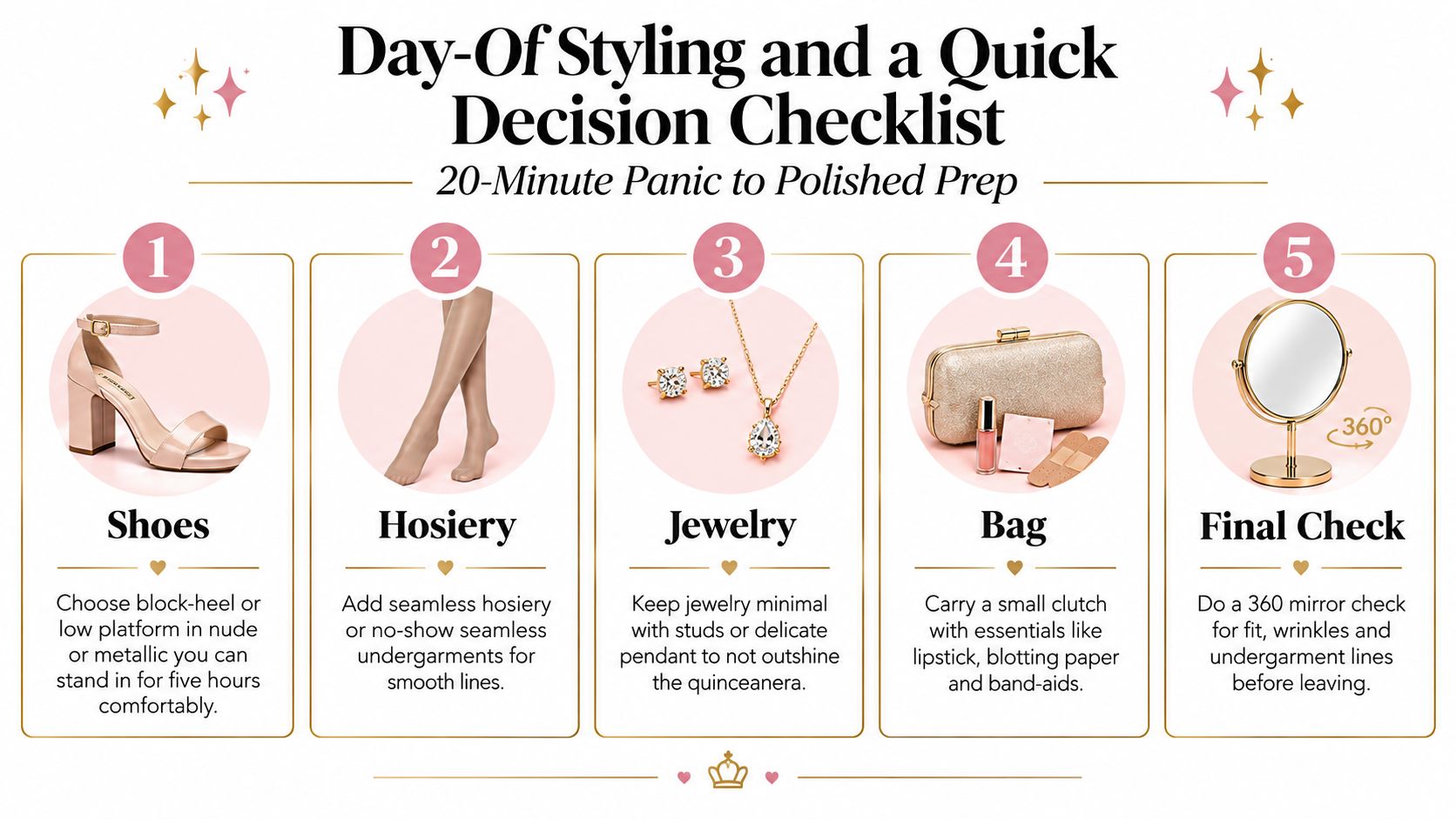
Styling rules that keep the outfit clean
Jewelry should follow the neckline, not your mood.
- High neckline: earrings and bracelet, skip the necklace
- V-neck or plunge: one focal piece
- Strapless or open shoulder: earrings plus necklace can work, but keep it balanced
Hair should answer the dress. If the back has detail, wear your hair up. If the front is the main event, soft hair down often looks better. Makeup should also pick one direction. Bold lip or stronger eye. Not both unless you're extremely disciplined about the rest of the styling.
If your family wants everyone's candid photos in one place after the party, how to have wedding guests upload photos is useful even for quince planning because the same guest-sharing problem shows up at any big family celebration.
A quick video can help if you're still deciding between “pretty” and “practical” styling choices.
Your leave-the-house checklist
Run this in front of a full-length mirror:
- Dress code match: Does it still make sense for both ceremony and reception?
- Color check: Are you clearly not matching the quinceañera or court?
- Hem check: Does it work with the shoes you're wearing?
- Undergarment check: No visible lines, slipping straps, or weird seams?
- Bag check: Fashion tape, safety pins, blotting sheets, bandages, lipstick
If you have to keep “fixing” the dress while standing still, it won't improve once the event starts.
The best quince guest dresses don't just look nice in a product photo. They survive church pews, family hugs, banquet chairs, bright flash, and a packed dance floor. That's the standard.
If you're heading to a quince and know the family will take hundreds of photos, keep the sharing part simple too. EventUploader lets hosts collect guest photos and videos through one link or QR code, which is perfect for a big celebration where cousins, aunts, and friends all catch different moments. It's an easy way to make sure the polished outfit photos and the fun dance-floor ones end up in the same place.